Draghilev method revisited - Mensajes

WroteRefined the algorithm and added examples
Hi. This solver is great, it's very stable and works in cases where I can't figure how it do things right. In the attached, I just clean the code a little, but the application it's entirely the same.
DistMod 2.sm (47,99 KiB) descargado 1717 vez(es).
DistMod 2.pdf (167,91 KiB) descargado 1002 vez(es).
Best regards.
Alvaro.
of arguments in the Dist and al_nleqsolve functions. Your program began to work much faster.
DistRazonar.sm (55,92 KiB) descargado 1724 vez(es).
I guess that the al_nleqsolve calls could be implemented as Draghilev method too.
DistBer.sm (53,4 KiB) descargado 1667 vez(es).
DistBer.pdf (181,65 KiB) descargado 997 vez(es).
Best regards.
Alvaro.
WroteI guess that the al_nleqsolve calls could be implemented as Draghilev method too.
Is that what you mean ?
Contour_10 Draghilev [Electron].sm (25,13 KiB) descargado 1533 vez(es).
WroteWroteI guess that the al_nleqsolve calls could be implemented as Draghilev method too.
Is that what you mean ?
Contour_10 Draghilev [Electron].sm (25,13 KiB) descargado 1533 vez(es).
Hi Jean. Yes, that, and the use of Dragilev (without h, I forgot that) method for solve nonlinear equations, as uni teach sometime ago.
Best regards.
Alvaro.
WroteHi Jean. Yes, that, and the use of Dragilev (without h, I forgot that) method for solve nonlinear equations, as uni teach sometime ago.
From recollection, original Uni [Viacheslav]
further exploited by Ber7 [smart cat !]
Buenos dias, Amigo.
The difference from the program distance to the curve in only one expression:
in the top line instead of i: = (1 ... 2)) we have i: = (1 ... 3).
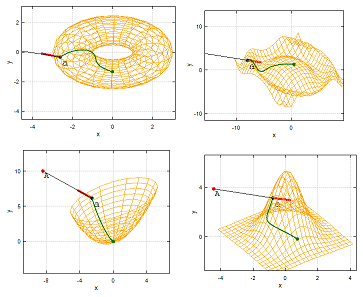
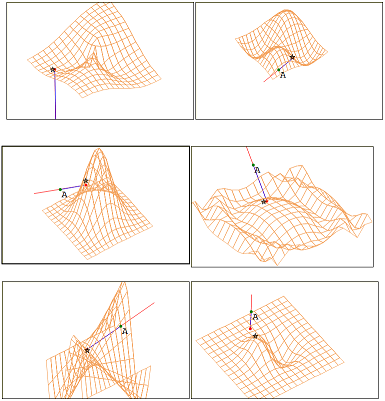
A is a given point, a is its projection to the surface, Аa (k) is the length of the segment Аa (k)
to the surface, the h-step of decreasing the distance, a (k) is the intermediate coordinate of
the point touch.The red line is the normal, the green is the trajectory of the movement of the
point a (k) from the initial the position of a (1) to the final a.I borrowed the trajectory
demonstration from Razonar,to whom I express my gratitude.
Dist3d.sm (63,12 KiB) descargado 1705 vez(es).
[url=https://www.geometrictools.com/Documentation/DocUpdateHistory.pdf]
https://www.geometrictools.com/Documentation/Documentation.html
WroteFinding Distance of a Point from Surface
The difference from the program distance to the curve in only one expression:
in the top line instead of i: = (1 ... 2)) we have i: = (1 ... 3).
Hi. Attached version have some reformulations, but is essentially the same, just added Lagrange multipliers for refine last point and join 3D and 2D in only one procedure. Maybe don't works in all cases, I guess that because use less points, but is more pedagogical from my point of view.
Dist.sm (172,04 KiB) descargado 1727 vez(es).
Dist.pdf (500,48 KiB) descargado 1030 vez(es).
Best regards.
Alvaro.
have a criterion to verify the accuracy of our calculations. For example,
you can use the vector product of unit vectors dist and normals,
whose modulus with perfect accuracy will be equal to to zero.
he magnitude of the deviation from zero characterizes the accuracy.
Agree Are you with this criterion?
Cross.sm (65,4 KiB) descargado 1740 vez(es).
WroteThank you, Razonar, for improving the program. I would like to
have a criterion to verify the accuracy of our calculations. For example,
you can use the vector product of unit vectors dist and normals,
whose modulus with perfect accuracy will be equal to to zero.
he magnitude of the deviation from zero characterizes the accuracy.
Agree Are you with this criterion?
Cross.sm (65,4 KiB) descargado 1740 vez(es).
Hi Ber. Thanks for say "our" calculations, but actually are yours. I just make some few modifications. Some general notes: It's a numerical procedure, so, guess values are part of the solution. Because of that, and the fact that you take a random external point I guess that my major modification can't get the global solution, and sometimes get only local ones. Each curve or surface need an specific general expression for the guess value in such case.
This is a small modification of your implementation, with some notes:
Cross.sm (73,37 KiB) descargado 1734 vez(es).
This is the modified implementation, and shows that the introduction of the Lagrangian multipliers for refine the last point get a very small cross third component value in all the cases where can find a solution.
Dist.sm (190 KiB) descargado 1763 vez(es).
This shows the importance of the initial guess value for seek the global solution
Dist_InitialGuess.sm (71 KiB) descargado 1805 vez(es).
So, answering your question, my conclusion is: Yes, you can use cross to show that, in 2D case the circle is locally tangent to the curve and, for the 3D case, a sphere is. But guess that for construction of your algorithm can't be used as a stop criteria because in your setup you need to move the point along the curve for seek the better approach.
But what I see is that I can find only local solutions, but not the global one. For that, given a random external point A to a curve or a surface you must to get the initial guess xo as a function of the given function and the point A, that's specific for each function.
Dragilev method can help here for finding the global distance because with that you know that you have a curve parametrization, so guess that only need to know in which direction you need to move, and estimate for how many 'time' you need to do that. Next, you use your algorithm and refine the last point with the Laplace multiplier to ensure that the circle centered in A is tangent to the curve.
But for the 3D case I don't see any help here, because with two parameters you lost the sort property of reals: plane points can't be sorted.
Hope that this notes helps.
Best regards.
Alvaro.
An example of the projection of points from one surface to another using the optimization methods in Maple.

WroteâFinding Distance of a Point from curve or surfaceâ
If Draghilev method wouldn't have been discovered, it could be solved otherwise,
by more conventional method ... like in the attached
1. Distance between user random triplets pairs.
2. Specified "user random" from one pair triplet [surface/solid]
3. Direction cosines plane [normal to solid] as one pair triplet
the 2nd triplet pair from solid.
Easy but not included: distance between helix/random-Brownian.
I'm lost in that thread, further latest SS don't read previous stable SS.
If Mathcad 11 and earlier can do w/o Draghilev, Smath earlier as well.
Cheers ... Jean
Vector Maths Direction Cosine [Dist-in-Space] Copy.sm (82,89 KiB) descargado 1640 vez(es).
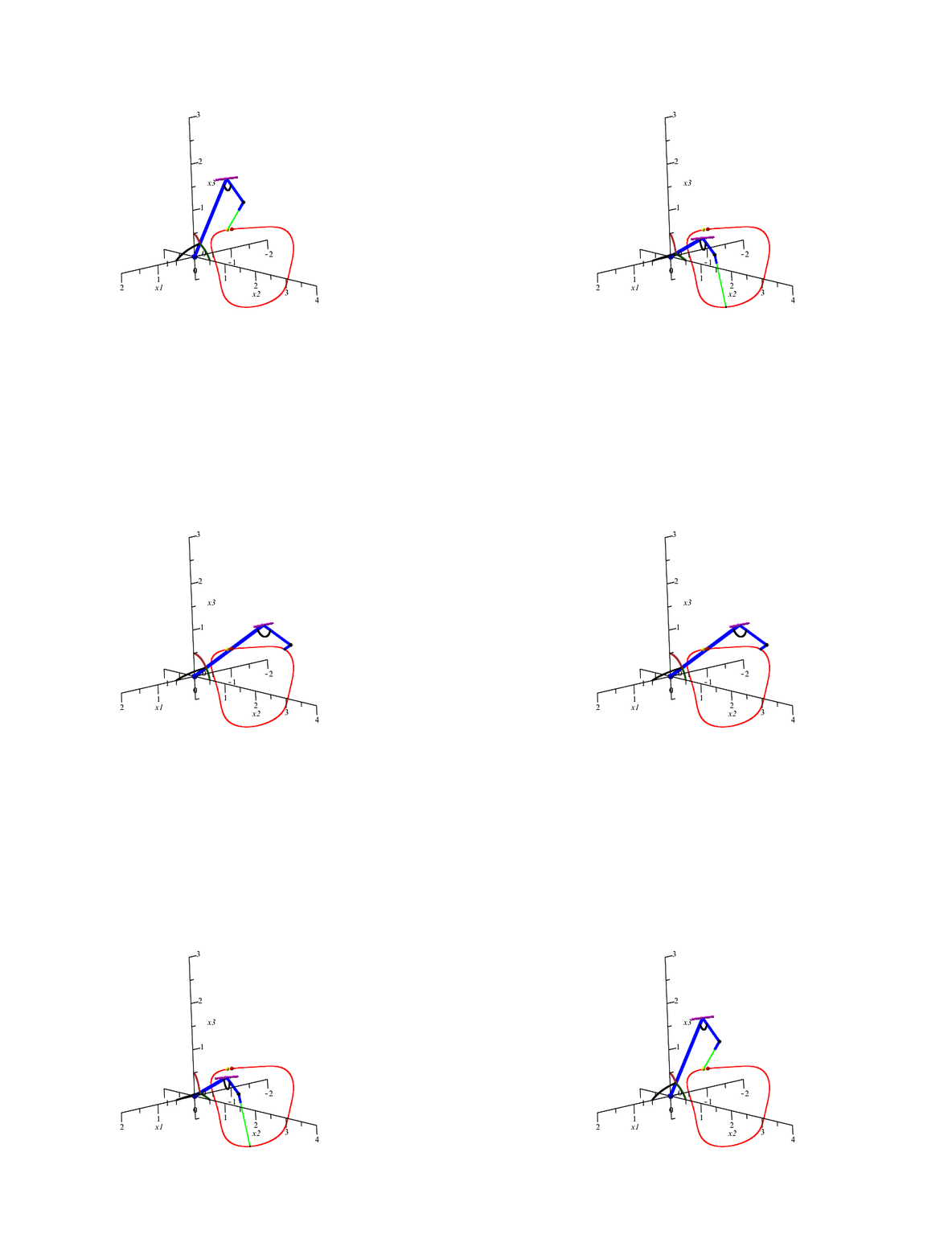
For example, as in the case of solving the inverse problem of kinematics for a three-link manipulator with a variable length of the working link. This manipulator has 6 degrees of freedom.
Dist2Dragilev.sm (71,68 KiB) descargado 1760 vez(es).
Dist2Dragilev.pdf (374,25 KiB) descargado 959 vez(es).
Best regards.
Alvaro.
Calculation procedure
1. We will use Draghilev's method
a) to parameterizethe curves and find a good initial guess.
We will use the point a0, found by the minimum distance
from the curve to a given point P.
b) to calculate the unit vector of the tangent T (x) to a
point on the curve.
2 To the system of equations we add an equation that
expresses the conditions of perpendicularityof the tangent
at the point x of the curve and the segment connecting the
points P and x. This means that the inner product of the unit
tangent vector to the curve f (x) and the unit vector Px is
equal to zero. As a result, we obtain the system of equations
3. We solve the system with the initial assumption a0
distantion.sm (124,14 KiB) descargado 1735 vez(es).
Trascidental curves.pdf (394,93 KiB) descargado 1038 vez(es).
ParSur.sm (74,98 KiB) descargado 1871 vez(es).
ParSur.pdf (619,79 KiB) descargado 1236 vez(es).
https://la.mathworks.com/help/matlab/ref/view.html
https://la.mathworks.com/help/matlab/creating_plots/setting-the-viewpoint-with-azimuth-and-elevation.html?lang=en
Gamma matrix for rotations.sm (74,69 KiB) descargado 1634 vez(es).
Gamma matrix for rotations.pdf (284,1 KiB) descargado 951 vez(es).
Best regards.
Alvaro.
- Nuevos mensajes
- Sin mensajes nuevos